
How to Measure Roof Pitch: 5 Accurate Methods
To measure roof pitch, find how many inches the roof rises for every 12 inches of horizontal run. The safest accurate method for most homes is to work from an exposed rafter inside the attic: hold a level horizontally, mark 12 inches of run, then measure vertically from that point to the rafter. A 6-inch rise over 12 inches of run is a 6:12 roof pitch. This guide also covers measuring from the roof surface, from the ground or a photo, with a speed square, and with a phone inclinometer.
On this page
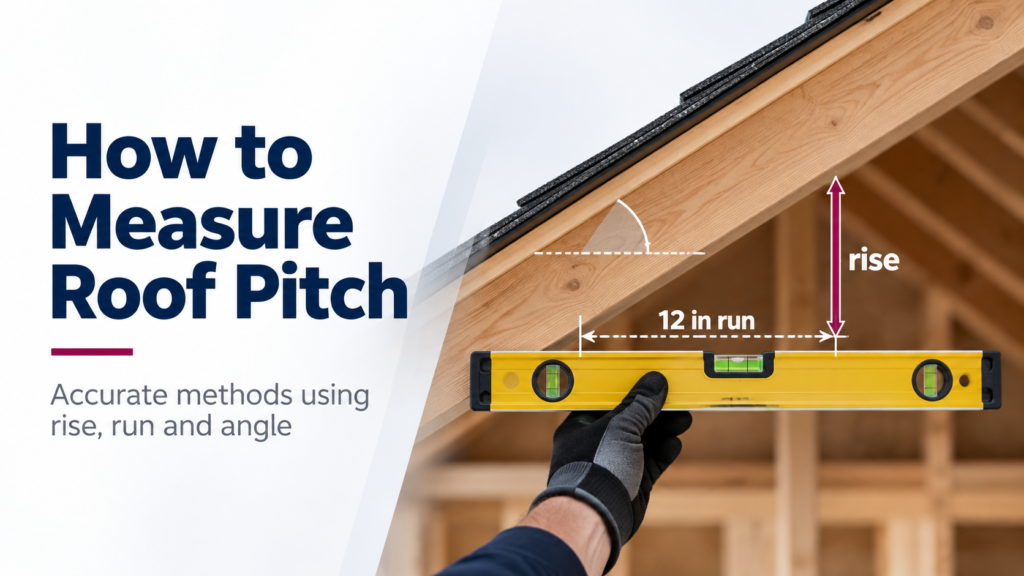
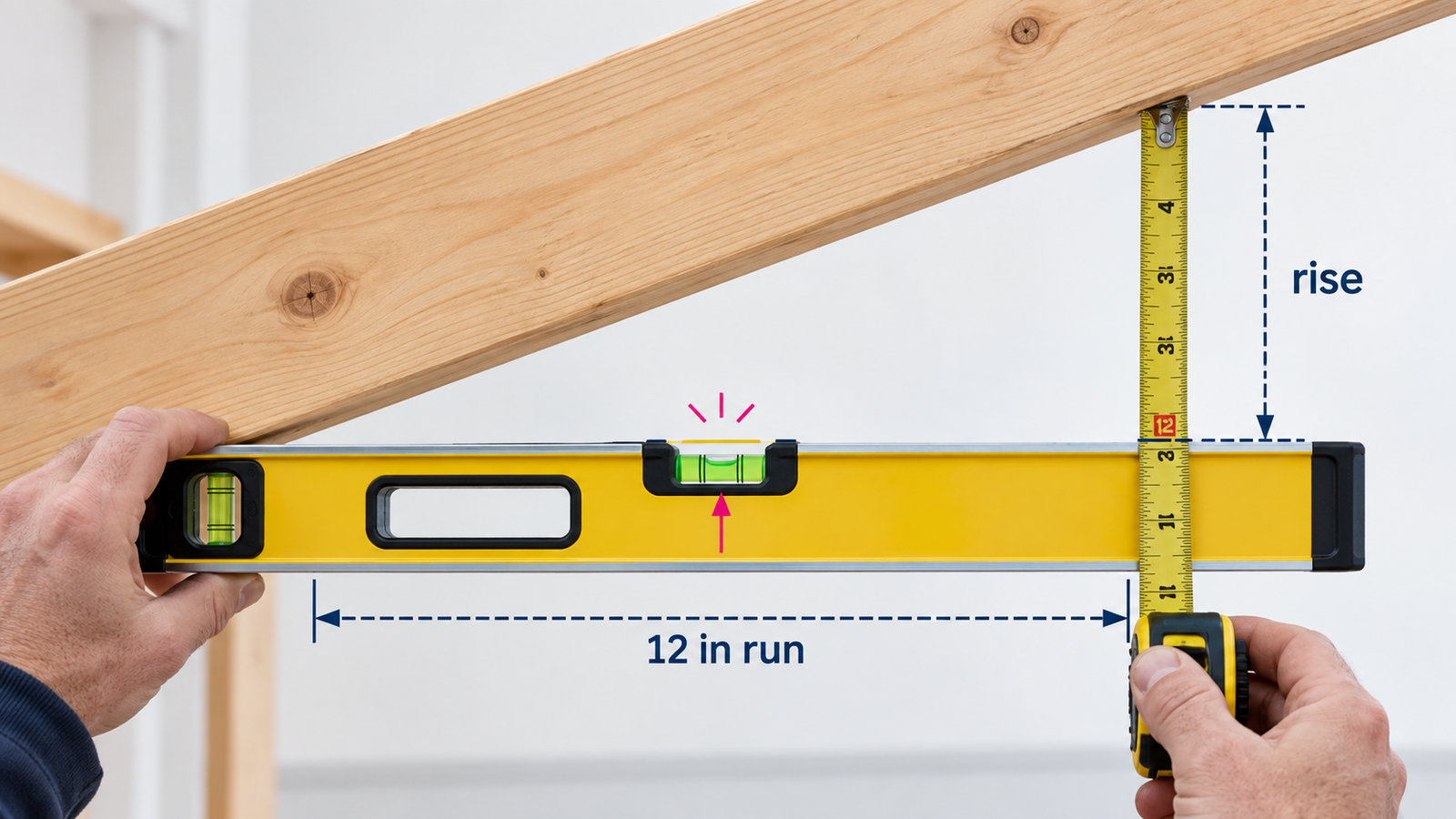
Measure a 12-inch horizontal run, then measure the vertical rise. If the roof rises 4 inches over 12 inches of horizontal run, the pitch is 4:12. If it rises 6 inches, the pitch is 6:12. When attic access is available, measuring against an exposed rafter is usually the best homeowner method because it gives a direct reading without needing to climb onto the roof.
What You Need to Measure Roof Pitch
For the standard level-and-tape method, you only need a few simple tools:
- a spirit level at least 12 inches long;
- a tape measure or ruler;
- a pencil or removable mark at the 12-inch point;
- good lighting if you are working in an attic.
Other methods can use a speed square or framing square, a digital angle finder, or a smartphone inclinometer. The goal is always the same: determine the relationship between vertical rise and horizontal run.
Which Roof Pitch Measurement Method Should You Use?
The best method depends on what part of the roof you can reach safely and how accurate the result needs to be.
| Method | Best for | Typical accuracy | Roof access needed? |
|---|---|---|---|
| Inside attic + level | Most homeowners with exposed rafters | High when measured carefully | No roof access |
| Roof surface + level | Professionals already working safely on the roof | High on a straight, even surface | Yes |
| Ground / side-on photo | No attic or roof access | Estimate; perspective can introduce error | No |
| Speed square | Visible rafters and carpentry work | High with the correct scale and setup | No if used in attic |
| Phone / digital inclinometer | Fast angle measurement | Good when calibrated against a straight surface | No if used on an attic rafter |
For ordering materials or making construction decisions, repeat the measurement and confirm it with a second method when practical.
Method 1: How to Measure Roof Pitch From Inside the Attic
Measuring from inside is one of the simplest ways to determine the pitch of an existing roof. The underside of a common rafter follows the same slope as the roof plane, so you can measure the geometry directly without standing on the roof.
- Find an exposed common rafter that follows the main roof slope.
- Hold a spirit level horizontally with one end touching the underside of the rafter.
- Centre the bubble so the level is truly horizontal.
- Measure exactly 12 inches horizontally from the point where the level meets the rafter.
- At the 12-inch mark, measure vertically between the level and the underside of the rafter.
- The vertical measurement in inches is the rise in the standard x:12 pitch.
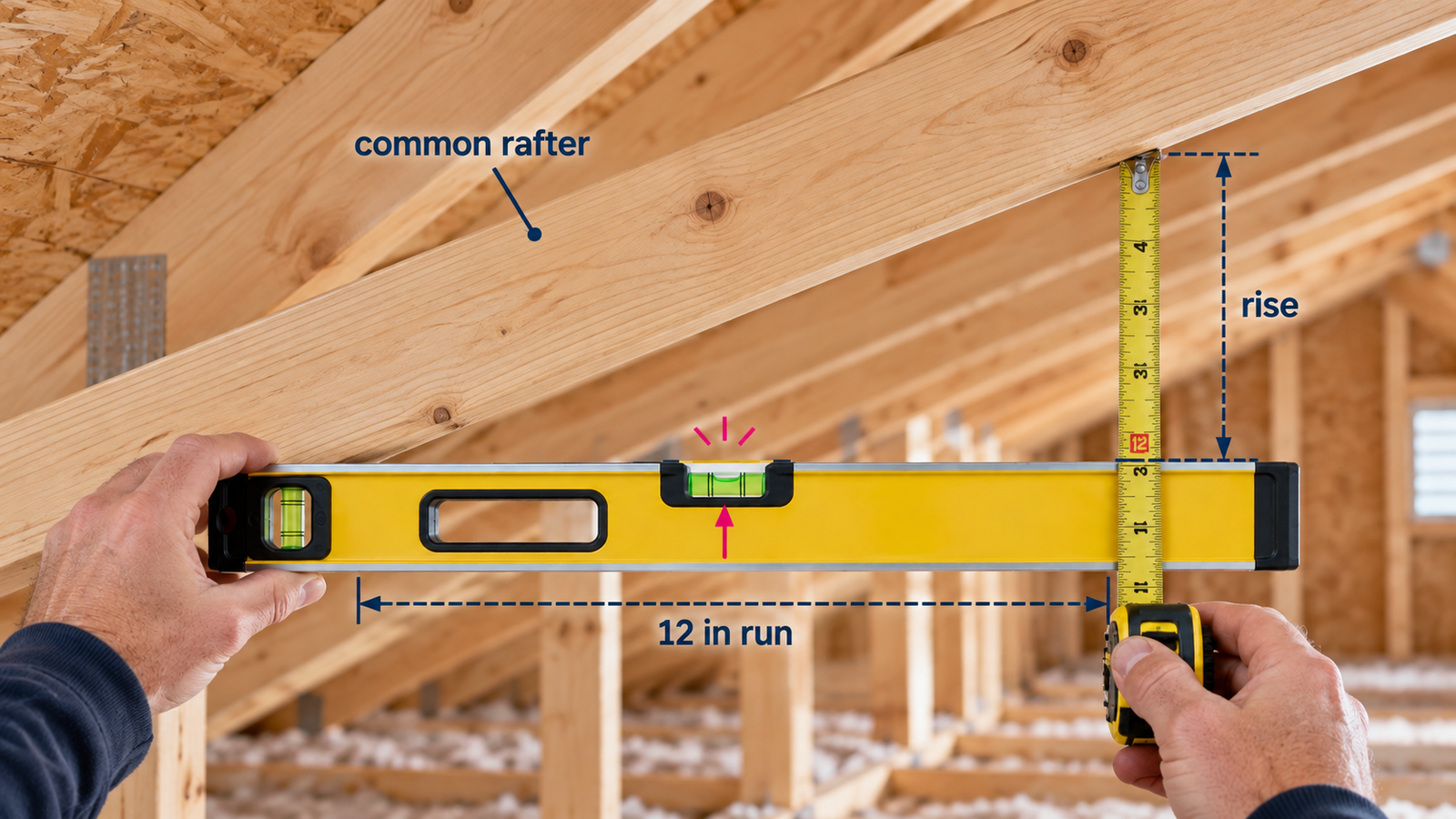
If the measurement is 5.5 inches rather than a whole number, the pitch is approximately 5.5:12. There is no need to round it to the nearest whole pitch if an exact calculation is useful.
Method 2: How to Measure Roof Pitch With a Level and Tape Measure
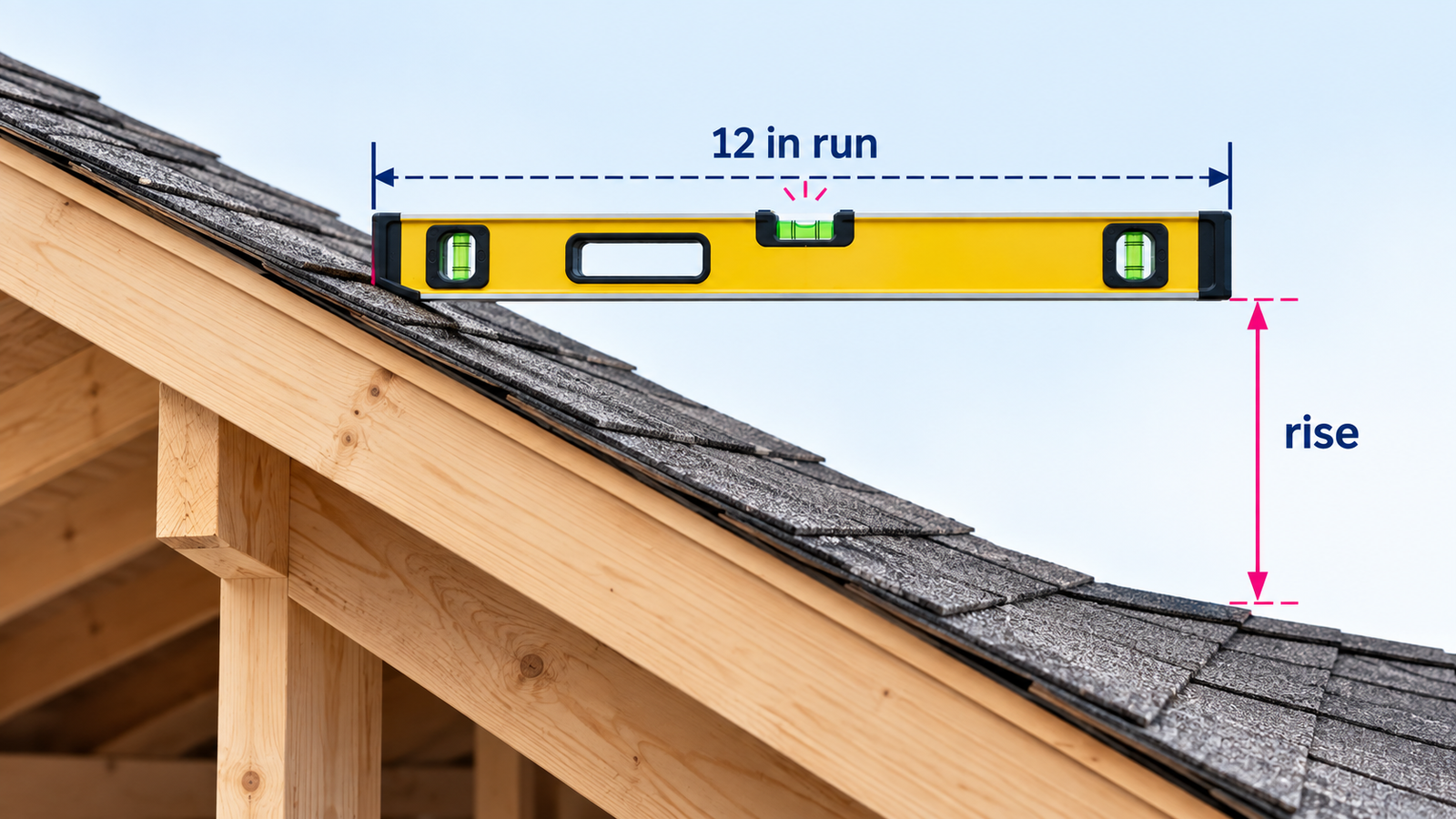
The same rise-over-12 method can be used on a roof surface when that surface is already safely accessible. This is the classic answer to searches such as how to measure roof pitch with a tape measure or how to measure roof pitch with a level.
- Place one end of a level against the roof surface with the level pointing horizontally across the slope.
- Centre the bubble so the level is horizontal, not parallel with the roof.
- Measure 12 inches horizontally along the level from the contact point.
- At that point, measure vertically down to the roof surface.
- Use that vertical measurement as the rise over 12.
For example, a 7-inch vertical gap at a 12-inch horizontal run gives a 7:12 roof pitch.
Method 3: How to Measure Roof Pitch From the Ground
If you cannot access exposed rafters, you can estimate roof pitch from the ground by looking at a clear gable end or by taking a straight-on photograph. This avoids roof access, but it is more sensitive to perspective than a direct rafter measurement.
Using a side-on gable photo
- Stand far enough back to see the full gable end.
- Position yourself as square to the gable as possible. Do not photograph it from a strong side angle.
- Keep the camera reasonably level so the eave line is horizontal in the image.
- On the image, measure the vertical rise from the eave line to the ridge.
- Measure the horizontal run from directly below the ridge to the eave.
- Convert that rise/run ratio to an x:12 pitch.
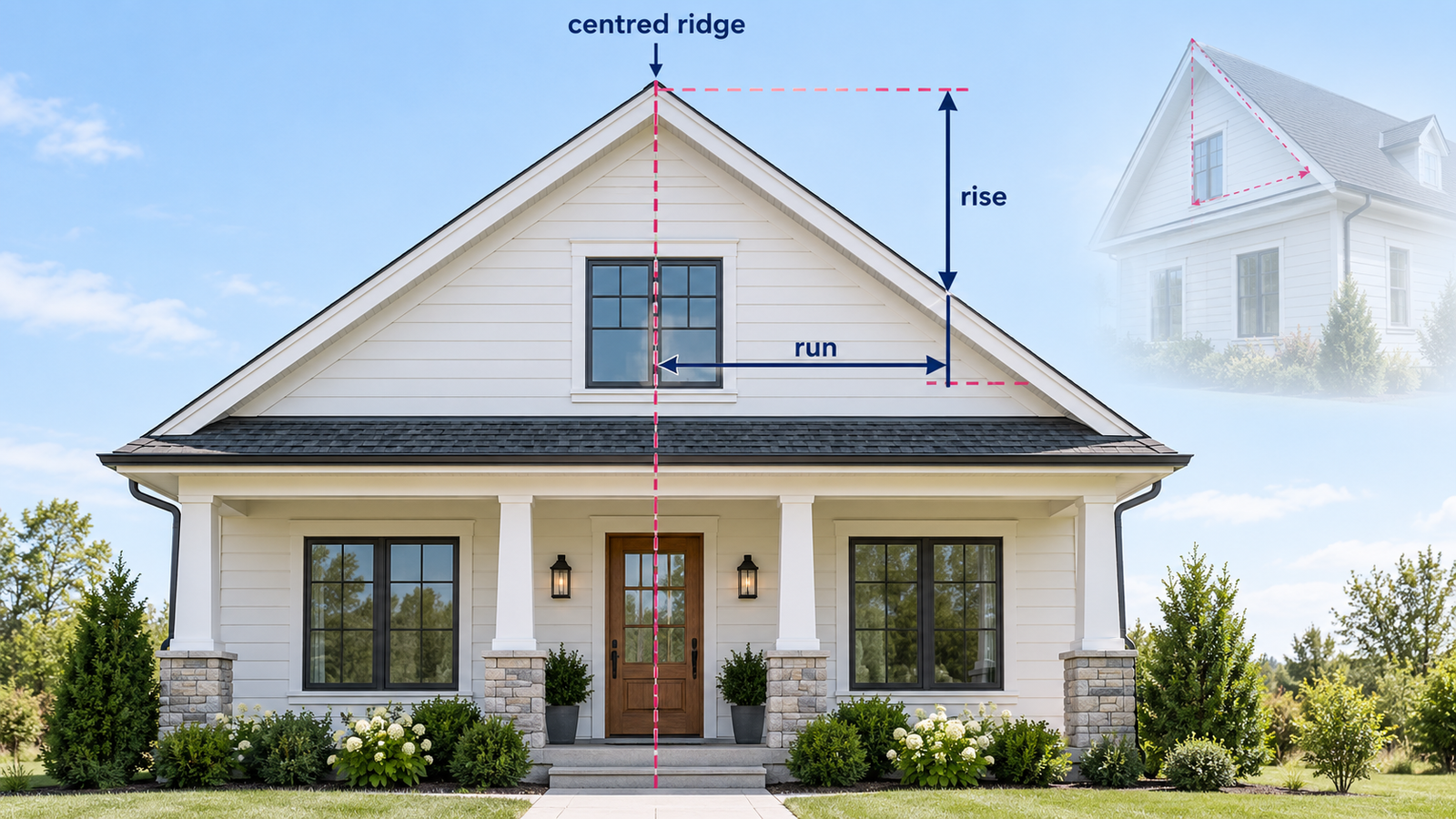
The measurement units on the photo do not matter as long as you use the same units for both rise and run. You can measure in pixels, millimetres or any other consistent unit because the calculation uses a ratio.
Method 4: How to Measure Roof Pitch With a Speed Square
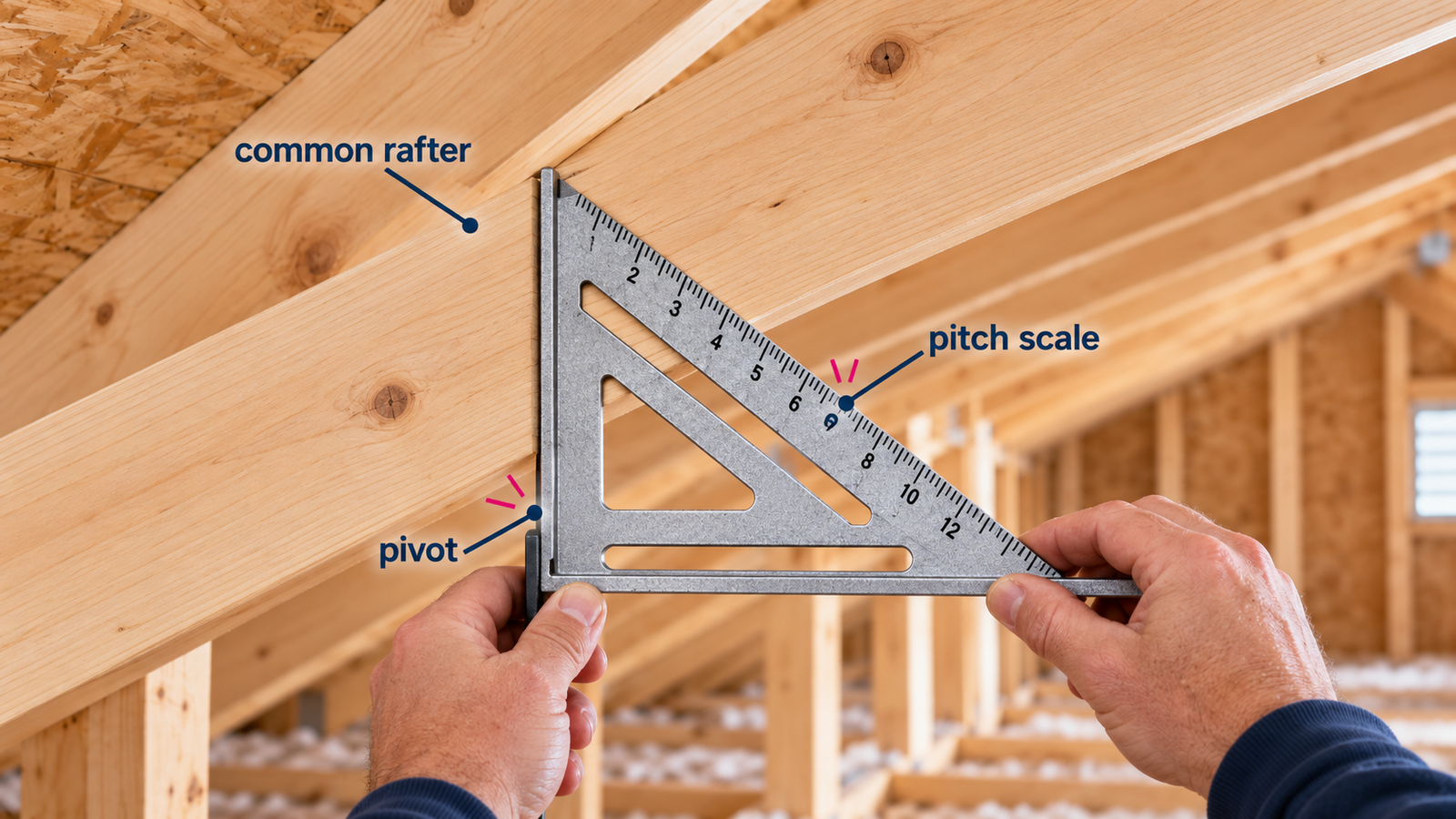
A speed square, also called a rafter square, can read the slope of a straight rafter quickly. Many speed squares include both a degree scale and a common-rafter scale.
Use it against a common rafter, not a diagonal hip or valley rafter. Keep the square firmly in the same plane as the rafter and use the reference markings specified by the manufacturer. If the tool has a common-rafter pitch scale, read the common-rafter value rather than the hip/valley scale.
Scale layouts vary between speed-square designs, so the exact reading procedure should follow the markings and instructions on your particular square. A small torpedo level can help establish a true horizontal or vertical reference where the method requires one.
Method 5: How to Measure Roof Pitch With an iPhone or Phone Inclinometer
A phone can measure the roof angle directly using its internal sensors. This is useful when searching for how to measure roof pitch with iPhone or when you have a digital inclinometer but not a level and tape.
- Open a reliable level or inclinometer function on the phone.
- Calibrate it according to the app or device instructions.
- Hold a long straight edge of the phone against a straight common rafter or other surface that follows the roof plane.
- Read the angle in degrees.
- Convert the degree reading to x:12 pitch using the formula below or our calculator.
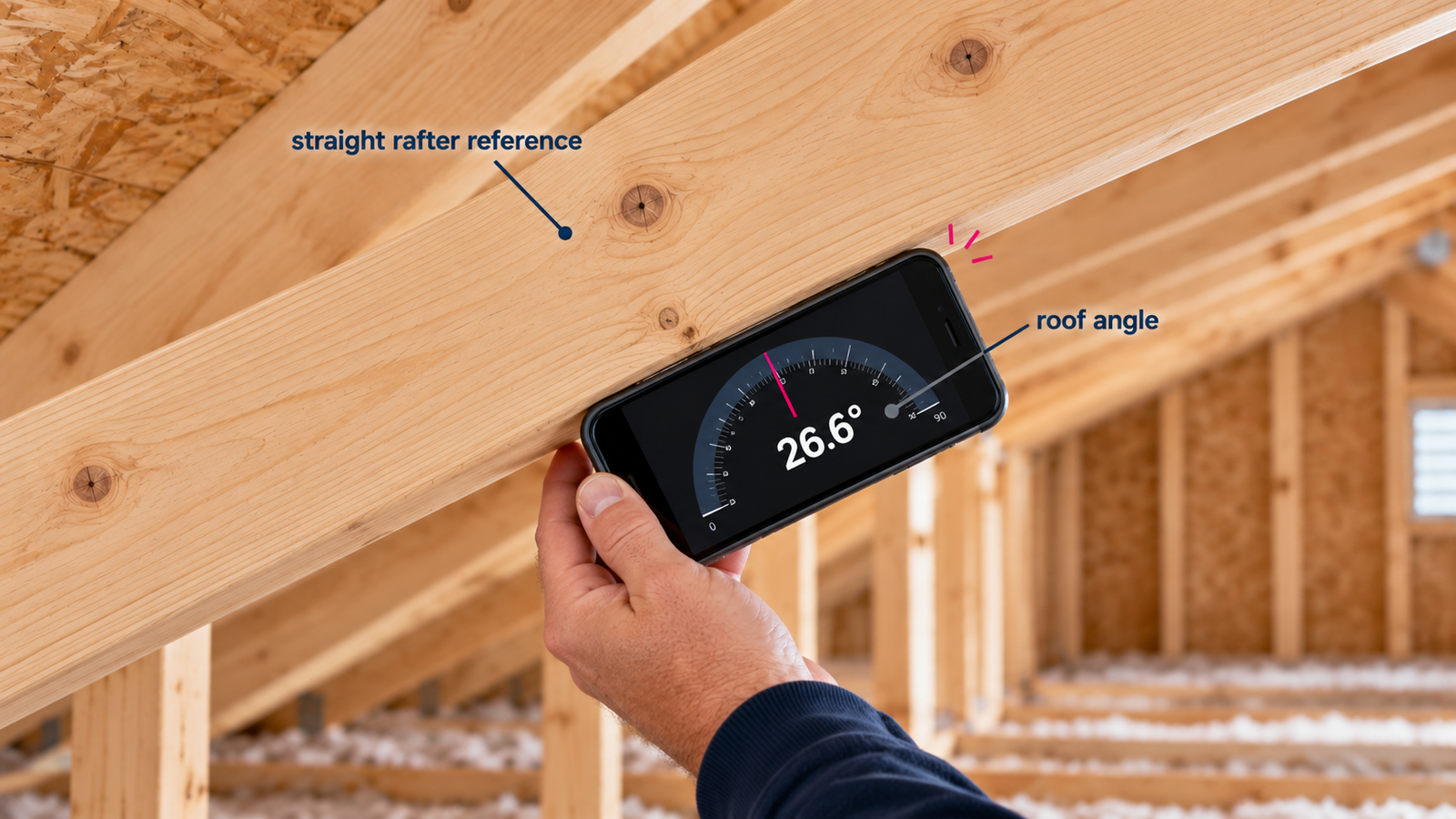
For example, an angle of approximately 26.57° converts to:
26.57° ≈ 6:12 roof pitch
A phone is only as accurate as the surface it is resting against and the device calibration. Holding it against a straight rafter is generally better than laying it across uneven shingles.
How to Measure Roof Pitch in Degrees
If you measured rise and run rather than an angle, calculate the roof angle using inverse tangent:
For a 6:12 roof:
If you want the degree value without doing the trigonometry manually, enter your measured rise and run into the Roof Pitch Calculator. You can also compare common values in the Roof Pitch Chart.
Roof Pitch Measurement Examples
| Rise measured over 12 in run | Roof pitch | Angle | Slope |
|---|---|---|---|
| 2 in | 2:12 | 9.46° | 16.7% |
| 3 in | 3:12 | 14.04° | 25.0% |
| 4 in | 4:12 | 18.43° | 33.3% |
| 5 in | 5:12 | 22.62° | 41.7% |
| 6 in | 6:12 | 26.57° | 50.0% |
| 8 in | 8:12 | 33.69° | 66.7% |
| 10 in | 10:12 | 39.81° | 83.3% |
| 12 in | 12:12 | 45.00° | 100.0% |
Angles are measured above horizontal and rounded to two decimal places.
How to Measure a Roof Pitch When the Run Is Not 12 Inches
You do not have to physically measure a 12-inch run. If you already know any corresponding rise and horizontal run, scale that ratio to a 12-inch run:
Suppose you measure a 20-inch rise over a 40-inch horizontal run:
The roof pitch is 6:12.
Common Roof Pitch Measurement Mistakes
Measuring along the roof instead of horizontally
The run is horizontal. The sloping distance along the rafter is not the run. Measuring along the roof surface and treating that value as the run gives the wrong pitch.
Using a level that is not actually level
A small tilt in the level changes the vertical gap. Centre the bubble before taking the rise measurement.
Measuring diagonally instead of vertically
The rise measurement must be vertical. Tilting the tape toward the rafter increases the measured distance.
Measuring a hip or valley rafter
A diagonal hip or valley rafter is not the same slope line as a common rafter. Use a common rafter or measure the roof plane itself.
Assuming every roof plane has the same pitch
Porches, dormers, additions, gambrel roofs and mansard roofs can have different slopes. Measure the specific roof plane you are working with rather than assuming the whole building shares one pitch.
Trusting a photograph taken at an angle
A photo taken from the side of the building rather than square to the gable can distort the roof geometry. Ground/photo measurements should be treated as estimates unless the image is well aligned.
How to Check That Your Roof Pitch Measurement Is Reasonable
Once you have a reading, use a few simple checks before relying on it:
- Repeat the measurement at least once.
- Measure a second common rafter when accessible.
- Check whether the converted angle visually makes sense.
- Compare the value against the Roof Pitch Chart.
- If you have a phone angle measurement, compare it with the level-and-tape result.
For example, a measured 6:12 pitch should convert to about 26.57°. If your phone reads 40° while your level-and-tape result says 6:12, one of the measurements needs to be repeated.
Why Accurate Roof Pitch Matters
Pitch is not just a descriptive number. It feeds directly into several other roof calculations.
Once you have the pitch, use the Roof Area Calculator to estimate surface area, the Rafter Length Calculator for rafter geometry, or the Roof Height Calculator for rise and ridge height.
Roof Pitch Measurement FAQs
What is the easiest way to measure roof pitch?
If exposed rafters are accessible, the attic method is usually the easiest accurate method: hold a level horizontally against a common rafter, measure a 12-inch run, then measure the vertical gap to the rafter.
How do you measure roof pitch with a tape measure?
Use a tape together with a level. Establish a horizontal run, preferably 12 inches, then use the tape to measure the corresponding vertical rise. A 5-inch rise over 12 inches of horizontal run is a 5:12 pitch.
How do you measure roof pitch from inside?
Measure against an exposed common rafter in the attic. Hold the level horizontal, mark 12 inches along it and measure vertically to the rafter at that mark.
How do you measure roof pitch from the ground?
A practical no-climb method is to take a straight-on photo of the gable end, measure rise and horizontal run on the image, and convert the ratio to x:12. Perspective can affect the result, so treat it as an estimate unless you can confirm it another way.
How do I measure roof pitch in degrees?
Use a digital inclinometer or phone level against a straight roof-slope reference, or calculate the angle with Angle = tan⁻¹(Rise ÷ Run). A 6:12 roof is approximately 26.57°.
Can I measure roof pitch with an iPhone?
Yes. A level or inclinometer function can read the angle when the phone is placed against a straight rafter or roof reference. Calibrate the device first and avoid relying on an uneven shingle surface when accuracy matters.
Can I measure roof pitch with a speed square?
Yes. Many speed squares include a degree scale and common-rafter scale. Use a straight common rafter, keep the square correctly referenced, and follow the scale markings on your specific tool. Do not confuse the common-rafter scale with a hip/valley scale.
What if my roof pitch is between standard sizes?
Keep the measured value rather than forcing it to the nearest whole pitch. For example, 5.5 inches of rise over 12 inches of run is approximately 5.5:12. The calculator can use non-standard values directly.
Should I measure every roof plane?
If the building has additions, dormers, porches, gambrel or mansard sections, measure each distinct slope that matters to your project. Different roof planes can have different pitches.
Measured the Rise, Run or Angle?
Enter the values you measured and get the exact roof pitch, angle, slope percentage, pitch factor and related geometry without converting everything by hand.
Calculate My Roof Pitch →Technical References
- Occupational Safety and Health Administration — Fall Protection in Residential Construction . Used for the roof-work safety context and fall-protection warning.
- This Old House — Understanding and Determining Roof Pitch . Describes attic, roof and ground-based approaches to determining pitch.
- Inch Calculator — Roof Pitch Calculator . Provides rise-over-run measurement methods and pitch conversion examples.